
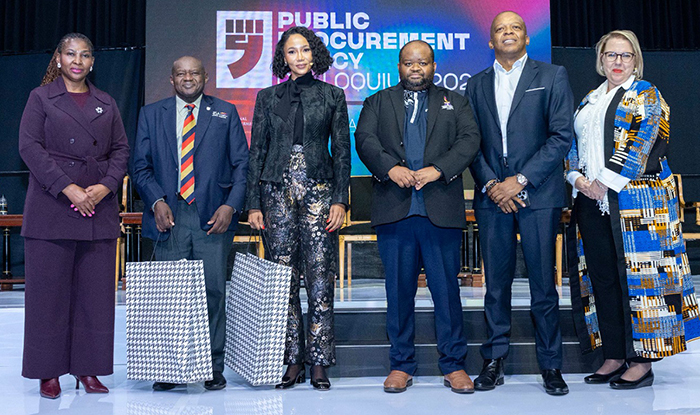
From left: Prof Ophillia Ledimo Academic Director: Unisa SBL; Dr Christopher Tshivhase, Unisa Vice-Principal: Teaching, Learning, Community Engagement and Student Support; Azania Mosaka, Programme Director; Prof Walter Matli, Executive Dean and CEO: Unisa SBL; Tshediso Matona, Commissioner of the B-BBEE Commission; and Prof Nellie Swart, Director Executive Education: Unisa SBL
Long before the final panel closed and delegates slowly filed out of the auditorium, one reality had already become impossible to ignore: South Africa’s public procurement debate is no longer only about compliance, regulation or process. It is about the future of economic inclusion, institutional trust and the state’s ability to deliver on its developmental mandate for the nation.
That was the spirit that carried the Public Procurement Policy Colloquium 2026, hosted by the Unisa Graduate School of Business Leadership (SBL) under the theme "Public Procurement Reform in South Africa: Opportunities, Risks and the Road to June 2026".
The urgency of the dialogue was sharpened by the draft General Public Procurement Regulations, 2026, under the Public Procurement Act, 2024, which are expected to reshape how government and state-owned entities manage procurement expenditure estimated at R2.7 trillion annually. For Unisa SBL and its strategic partners, the colloquium was therefore not only a discussion about regulation, but a timely intervention ahead of the 15 June 2026 public submissions deadline to National Treasury and Parliament.
Throughout the day, the conversations moved deliberately between policy, governance, ethics, industrialisation and transformation. Beneath every discussion sat the same underlying question: How can South Africa build procurement systems that are transparent, developmental and capable of restoring public confidence?
In setting the tone for the engagement, Dr Christopher Tshivhase, Unisa's Vice-Principal: Teaching, Learning, Community Engagement and Student Support, reflected on the responsibility of universities to actively participate in shaping the country’s most urgent national conversations. "Universities must not stand at the margins of society’s most urgent conversations. We must help shape them with evidence, courage and a deep commitment to public good," said Tshivhase.
That sense of responsibility echoed throughout the programme as speakers challenged delegates to think critically beyond procurement as a technical or administrative exercise. Instead, procurement was repeatedly framed as one of the state’s most powerful strategic instruments for transformation, industrial development and inclusive economic participation.
For Prof Walter Matli, Executive Dean and CEO of Unisa SBL, the conversation ultimately returns to leadership. "Public procurement reform is not only about systems and regulations. It is about leadership, accountability and the choices we make in service of a more capable and inclusive society," said Matli.
As discussions deepened throughout the panel sessions, delegates grappled with the tensions between policy ambition and implementation realities. Questions around governance failures, regulatory complexity, localisation, infrastructure delivery and ethical accountability became central to the day’s engagement.
One of the most significant interventions came from Tshediso Matona, Commissioner of the B-BBEE Commission, who cautioned against allowing transformation to become superficial or symbolic. "Transformation cannot remain a box-ticking exercise. It must produce meaningful, measurable outcomes that expand participation, strengthen enterprises and change the structure of the economy," said Matona.
His remarks reinforced a broader concern raised throughout the colloquium, namely that procurement reform must remain aligned with constitutional principles, economic inclusion and South Africa’s broader developmental agenda, if it is to produce sustainable impact.
As the country moves closer to 15 June 2026, the colloquium highlighted both the urgency and complexity of reform. While procurement remains one of the state’s most powerful tools for driving industrialisation, SME growth and public value, speakers acknowledged that fragmented implementation and policy misalignment risk weakening its transformative potential.
The colloquium reflected the importance of collaboration in shaping sustainable reform. Unisa SBL extended its appreciation to its strategic partners, speakers, moderators and stakeholders whose contributions strengthened the quality and depth of the national dialogue.
As a fitting parting reflection, Prof Ophillia Ledimo, Academic Director of Unisa SBL, drew together many of the themes that had surfaced throughout the colloquium. Her remarks challenged delegates to consider not only what procurement systems measure, but how institutions use information to improve decision-making and deliver public value.
"The persistent gap between procurement data collection and procurement decision-making reflects an institutional culture that prioritises reporting over learning and compliance over performance," said Ledimo.
As delegates departed, her remarks left an important challenge lingering in the room - that the success of procurement reform will ultimately depend not only on new regulations, but on the ability of institutions to turn information into insight and insight into action.
* By Thina Gwiliza, Communications and Marketing Specialist, Unisa SBL
** Photography by Mduduzi Khatamzi, Unisa Multimedia Centre
Publish date: 2026-06-11 00:00:00.0
Contact the Marketing and Communication office: Ms Thina Gwiliza at gwilita@unisa.ac.za
011 652 0339
Telephone: +27 11 652 0248 / +27 11 652 0291
Email: sbl@unisa.ac.za
Physical Address:
Cnr Janadel and Alexandra Avenues
Midrand, 1686
Gauteng, South Africa
Download map & directions (PDF)