

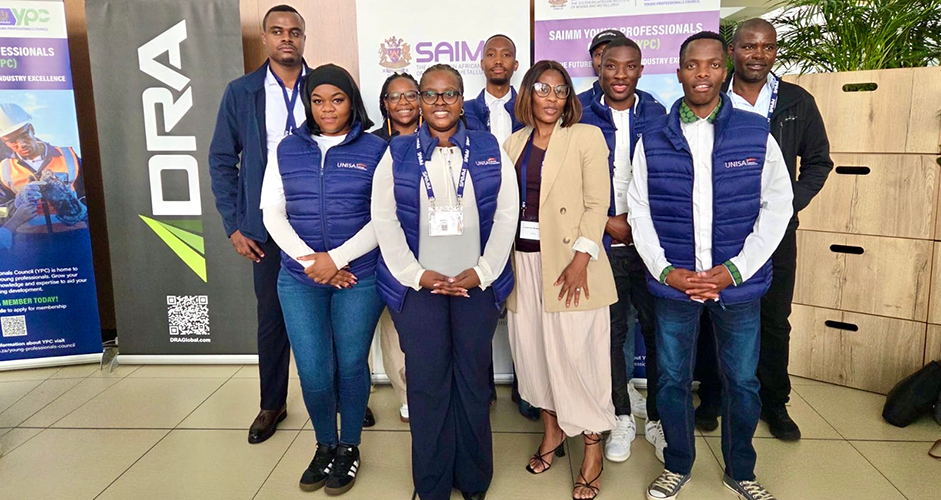
For a group of Unisa Mining Engineering students, the inaugural SAIMM YPC Student Debate was about far more than winning.
For some of the students, the biggest hurdle was not standing up to debate. It was believing they belonged in the room in the first place.
That changed when students from the University of South Africa (Unisa), the University of Johannesburg (UJ) and the University of the Witwatersrand (Wits) gathered at DRA Global in Johannesburg for the inaugural Southern African Institute of Mining and Metallurgy Young Professionals Council (SAIMM YPC) Student Debate.
For the Unisa team, the occasion marked an important first. They were representing the University in the forum for the first time, entering a space where technical knowledge was only part of the challenge. They also had to think on their feet, defend their positions and communicate their ideas with confidence.
Being selected brought a mixture of excitement, nerves and responsibility.
"The moment I saw my name, I felt like I was carrying the Unisa flag for all of us. It was joy, nerves, and responsibility all at once," said Oratile Aphiri.
That responsibility remained with the team throughout their preparation. As open distance e-learning students, many are accustomed to managing their studies independently while balancing other commitments. Preparing for the debate added another demanding task, with examinations also approaching.
The students had to research the topic, develop arguments, study statistics, prepare points of information and practise rebuttals. They quickly realised that teamwork would be critical.
"Balancing the debate information and exams was already a lot. We overcame it by making a study plan, leaning on the team and drilling the case every night. The team kept me accountable. We turned stress into preparation," Aphiri said.
The pressure was heightened by the fact that the Unisa team had no previous experience in this particular debating space. Rather than allowing that to unsettle them, the students used it as motivation.
"People were not expecting us to pose a threat. We overcame this by turning that pressure into our fuel. We spent sleepless nights researching, refining our arguments and practising until our delivery was flawless," said Kemoneilwe Matsane.
The debate also challenged the students to look beyond the technical aspects of Mining Engineering.
Their academic work covers areas such as rock mechanics, ventilation and beneficiation. The debate, however, required them to consider the broader forces shaping the mining sector, including policy, economics and the industry’s future.
For Aphiri, this was one of the most valuable aspects of the experience.
"In Mining Engineering we learn the technicals, but SAIMM forces you to defend policy, economics and the future of our industry out loud," she said.
Sharing the platform with students from UJ and Wits added another layer to the experience. The students were exposed to different perspectives, questioned their own assumptions and learned from their peers.
Much of that learning happened in the pressure moments: responding to difficult questions, defending a position and remaining composed before an audience.
"I felt privileged to represent the oldest and biggest institution in South Africa at our first inception of the SAIMM student debate," said Machela Konyana.
Konyana also encountered a challenge she had not anticipated.
"Managing a crowd has been a huge challenge, and my preparation did not anticipate a mass gathering," she said.
The experience reinforced an important lesson for the students: effective communication is not simply about knowing what to say. It also requires the ability to read an audience, remain calm under pressure and connect with people.
For the students, those lessons mattered regardless of the outcome. They wanted to emerge from the experience as stronger communicators, more confident speakers and future professionals capable of engaging meaningfully with the mining industry.
"Beyond winning, I want to learn confidence in public speaking, how to think on my feet and how to network with industry professionals at SAIMM," Aphiri said.
The opportunity to build professional relationships was another highlight. Meeting fellow Mining Engineering students, exchanging ideas and establishing connections with people in the industry gave the students a broader perspective on their future careers.
They also acknowledged the support that made their participation possible, particularly the contribution of Dineo Johannes Poopedi, whose persistence helped ensure that the students met the requirements and were able to participate.
The students also paid tribute to their mentors in the Department of Mining, Minerals and Geomatics Engineering, describing them as "pillars of strength" who encouraged them to believe in themselves and recognise the value they could bring to the profession.
Perhaps the most powerful lesson from the debate was one the students wanted to share with their fellow Unisa students: confidence should not be a prerequisite for taking an opportunity.
"Don’t tell yourself, 'I'm from Unisa, maybe I’m not good enough'. You are. These platforms are for us too," Aphiri said.
Matsane echoed the sentiment, urging students not to allow the “underdog” label to define their potential.
"As open distance e-learning students, we are already built for independence and hard work. When opportunities from bodies like SAIMM arise, grab them with both hands," she said.
The students are already looking beyond their first debate and thinking about how to create more opportunities for their peers.
One proposal is to establish regular internal debates, with a new topic selected each month. Such a platform would allow students to strengthen their research, argumentation, rebuttal and public-speaking skills throughout the year.
They have also suggested developing two teams, creating opportunities for new students to participate while allowing more experienced speakers to mentor others and continue developing their own skills.
For a team that entered the SAIMM student debate for the first time, the experience could therefore mark the beginning of something much bigger.
The debate lasted only one evening, but its impact could extend much further, into the students’ studies, workplaces, professional networks and, ultimately, the mining industry.
Their reflection on the experience perhaps captures it best:
"We went, we saw, we learnt."
And now, they are ready for the next opportunity.
* By Lindelwa Makhanya, Department of Mining, Minerals and Geomatics Engineering
Publish date: 2026/09/18

 Unisa Law Clinic celebrates two newly admitted attorneys
 Unisa scholar seeks to strengthen youth work through research and policy influence
 Unisa celebrates legacy and growth at 19th Chancellor's Calabash Awards
 African youth icon DJ Sbu to deliver keynote at 2026 Unisa Innovation Festival
 Unisa staff member earns Master's Degree with distinction while balancing work and research