
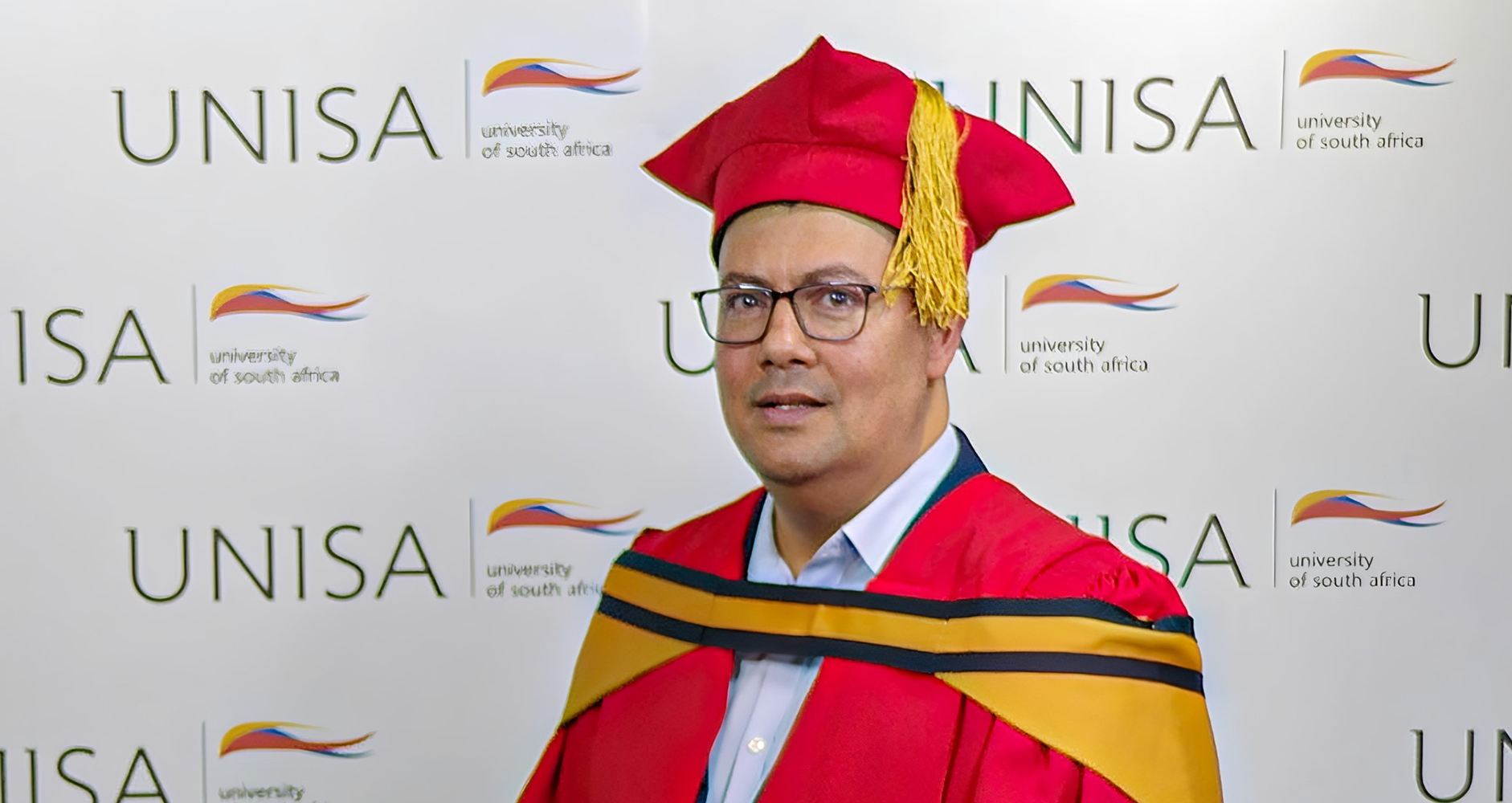
Prof Brendon Barnes of Unisa's Institute for Social and Health Studies delivered his inaugural lecture, exploring how psychology can advance climate justice and support youth-led climate activism.
The University of South Africa (Unisa) celebrated an important academic milestone when Prof Brendon Barnes of the Institute for Social and Health Studies in the College of Human Sciences delivered his inaugural lecture.
The lecture marked the formal recognition of Prof Barnes as a full professor and provided an opportunity to reflect on a career shaped by research at the intersection of psychology, climate change and environmental justice.
Speaking to colleagues, students, family members and distinguished guests, Prof Barnes reflected on the lessons that have shaped his academic journey. He emphasised the importance of remaining curious about the social world, approaching research as a collaborative endeavour and ensuring that scholarship has an impact beyond academic publications and statistics.
"I have learnt that research should not only generate knowledge, but should also contribute positively to society," he said, while acknowledging the unwavering support of his family throughout his career.
At the centre of his lecture was the role psychology can play in responding to climate change and advancing climate justice.
Prof Barnes argued that climate change and environmental pollution do not affect all communities equally. Poor and vulnerable populations, particularly women and children, often bear a disproportionate share of the consequences of environmental degradation.
Drawing on his extensive research, he demonstrated how psychology can contribute to climate justice by identifying environmental injustices, drawing on different research methods and theoretical perspectives, supporting climate activist organisations and strengthening networks advocating for sustainable and equitable solutions.
His work has extended beyond South Africa, with research and collaborations spanning countries including Uganda, Brazil, Haiti, Canada and the United Kingdom.
He is currently collaborating with the University of Sussex on research examining the relationship between climate change and migration. Another international partnership involving the University of Cincinnati and Wilfrid Laurier University in Canada focuses on youth climate activism.
These collaborations reflect his commitment to using social science research to deepen understanding of climate-related challenges while building partnerships across institutions and countries.
For Prof Barnes, academic leadership extends beyond research. Developing future scholars through teaching, supervision and mentorship is an equally important part of his work.
Throughout his career, he has supervised six postdoctoral fellows, eight doctoral candidates and 25 master's students. He takes pride in seeing the scholars he has mentored develop academically and professionally.
He distinguishes between supervision, which is primarily focused on guiding postgraduate students through their research, and mentorship, which can provide broader support for academic and professional development.
His approach to teaching is driven by a desire to develop a new generation of multiskilled social scientists equipped to tackle complex challenges such as climate change.
He also advocates for greater opportunities for work-integrated learning earlier in students' academic journeys, arguing that practical exposure can help prepare students for an increasingly complex and changing professional environment.
Looking to the future, Prof Barnes plans to deepen his research and engagement with climate activism, with a particular focus on working alongside and supporting young climate activists.
He believes young people are central to climate action and have the potential to play a transformative role in building a more sustainable and just future.
His plans include strengthening international research collaborations that advance climate justice while amplifying the voices and experiences of communities most affected by environmental and climate-related challenges.
Prof Barnes's inaugural lecture celebrated more than his appointment as a full professor. It offered a reflection on a scholarly career grounded in the belief that research should have a meaningful purpose in society.
Through his work in psychology, climate change and environmental justice, as well as his commitment to teaching, supervision and mentorship, he continues to explore how social science can contribute to addressing one of the defining challenges of the contemporary world.
His focus on climate justice and youth activism also points towards the next chapter of his academic journey: using research, collaboration and the development of future scholars to help build a more equitable and sustainable future.
* By Dr Khabo Maduna, Communication and Marketing Specialist, CHS
Publish date: 2026/09/18

 Unisa Law Clinic celebrates two newly admitted attorneys
 Unisa scholar seeks to strengthen youth work through research and policy influence
 Unisa celebrates legacy and growth at 19th Chancellor's Calabash Awards
 African youth icon DJ Sbu to deliver keynote at 2026 Unisa Innovation Festival
 Unisa staff member earns Master's Degree with distinction while balancing work and research